
From: Dylan Borland Interview
Topic deep dive
Consciousness, Psi & the Nature of Reality
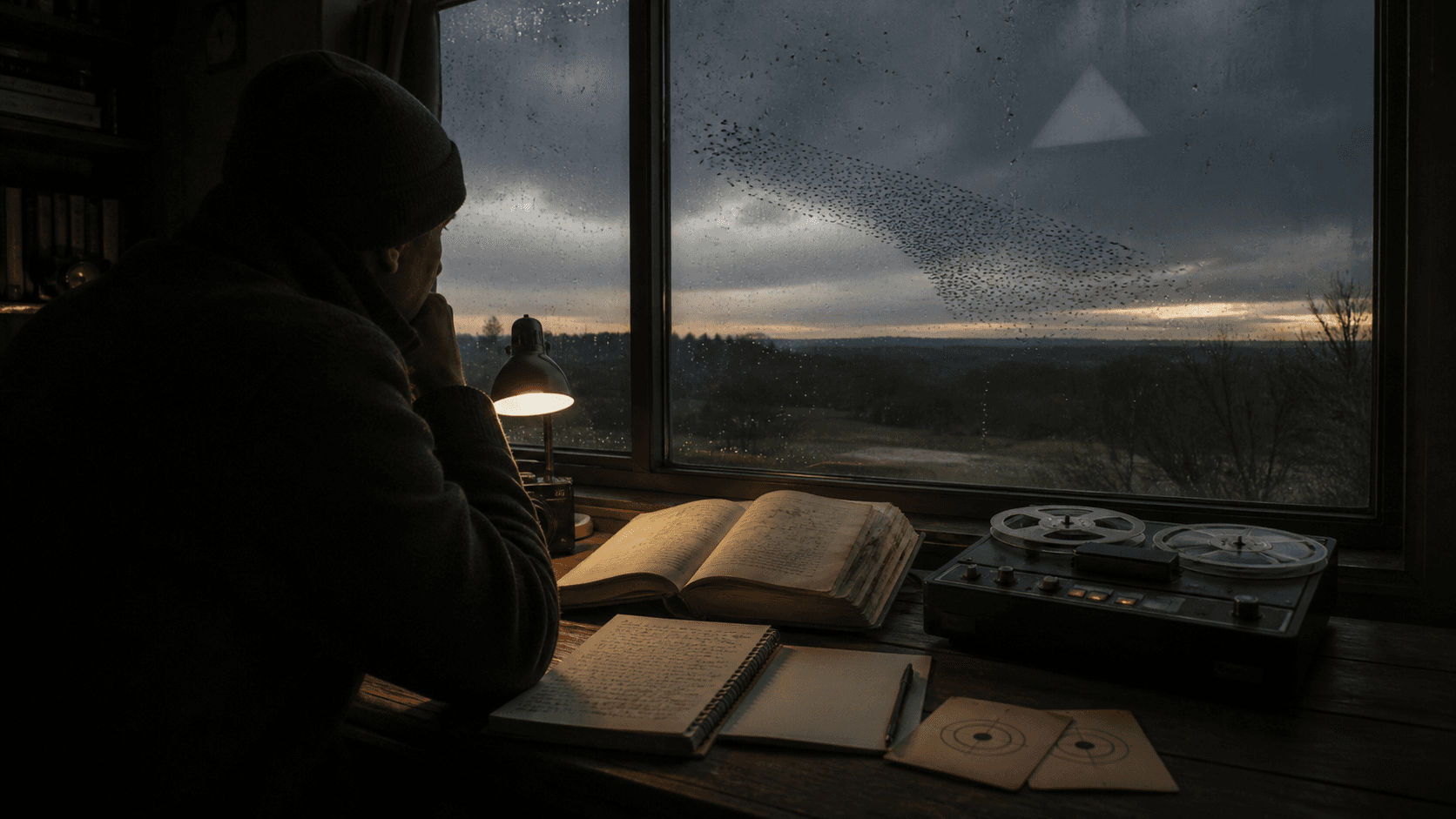
By the final hour, the interview has moved well beyond one triangle at Langley. Borland and Michels discuss remote viewing, predictive dreams, false memory, simulation, theology, and the possibility that encounters matter partly because of what they do to human consciousness.
Source account
What Was Said
Borland says he accepts remote viewing and predictive-dream possibilities while asking for stronger evidence than distant lights before calling a conscious experience contact with non-human intelligence. He and Michels trade personal synchronicity stories, then move into memory, perception, and the difficulty of attributing an experience to a human agency, a foreign actor, a private company, or something non-human.
The discussion later uses computational and simulation analogies to think about time, recurring patterns, and reality. Borland also describes long conversations about the Book of Enoch and theology with Paul Thigpen, a mentor he remembers as both spiritually curious and careful.
None of these philosophical models is established as fact in the interview. They are part of the speakers’ effort to make sense of experiences and claims that do not fit comfortably inside one category.
Key moments
Follow the sequence
- 01
Remote viewing with a threshold
Borland is open to psi but asks for evidence closer and clearer than a distant light.
- 02
Attribution problem
The speakers ask how a person could separate anomalous influence from human mind-control or memory manipulation.
- 03
Synchronicity
Both share personal stories that they interpret as meaningful coincidence or consciousness effects.
- 04
Simulation
The discussion uses recurring mathematics and client/server analogies to imagine reality as a constrained computation.
- 05
Theology
Enoch, angels, demons, souls, moral purpose, and other traditions enter as interpretive frameworks.
- 06
Control
They speculate that UAP events may disrupt beliefs, organize groups, and change the people who encounter them.
UAPverse Read
What this path changes
This is the branch where the interview reveals what Borland is really trying to reconcile: an object he remembers as physical, institutions he believes hold material evidence, and experiences that push him toward questions about mind, purpose, and control. The value is not in forcing those ideas into one answer. It is seeing why the same conversation keeps moving between hardware and consciousness.
One question to sit with
Why does a conversation that begins with a physical object over Langley keep arriving at consciousness, memory, theology, and the possibility that the experience changes the observer?
Explore this topic further
Open a closer path
Related