
From: Dylan Borland Interview
Topic deep dive
Experiencer Testing
Borland’s account of VA treatment is strange on its own. The conversation gets stranger when he connects it to a cited call about testing veterans, government personnel, and people described as experiencers or “hybrids.”
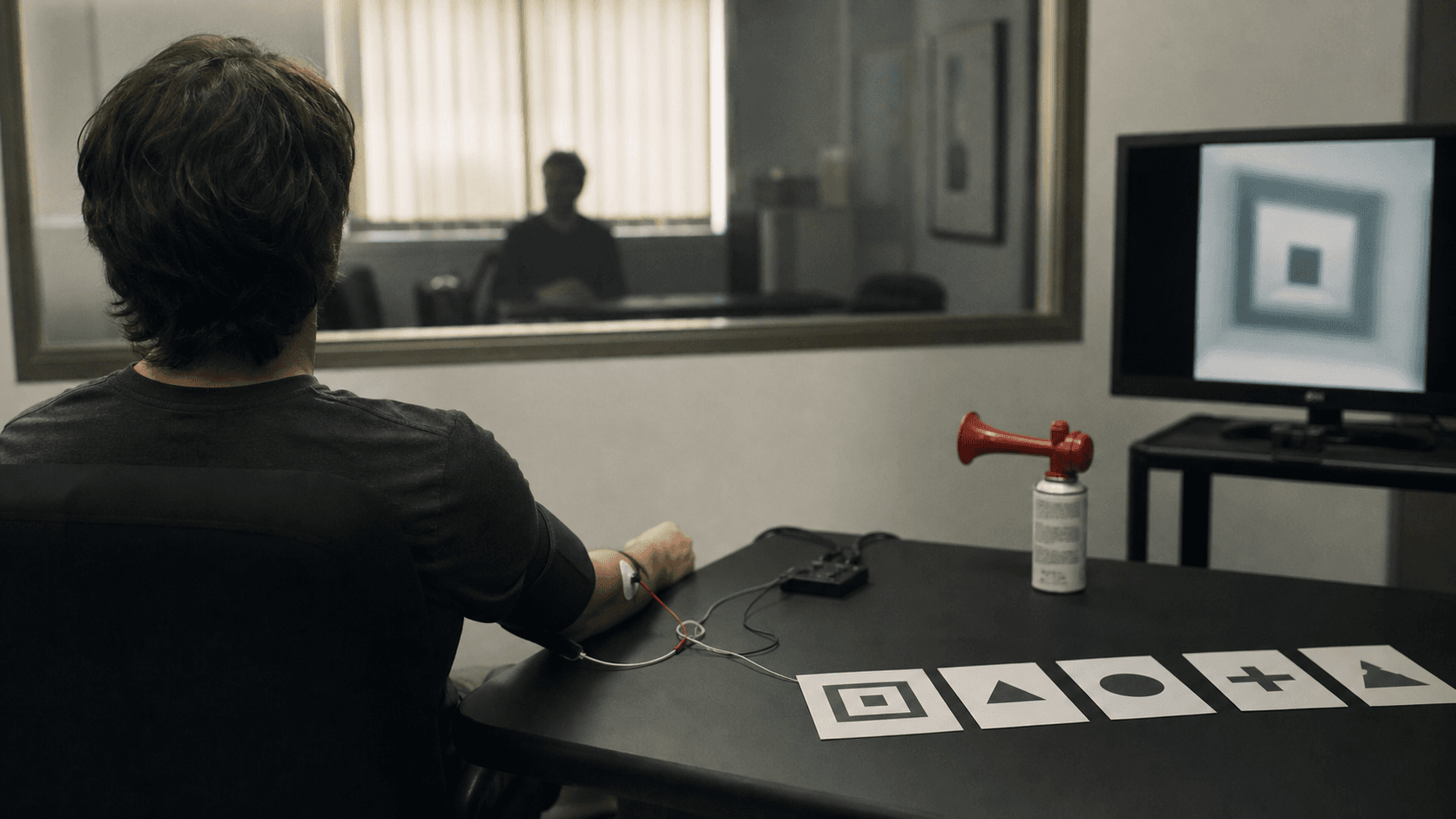
Source account
What Borland Said
Borland says that in 2016 and 2017 he was connected to equipment in a VA setting while images flashed on a screen. He describes a pressure cuff, head sensors, heartbeat monitoring, repeated MRI scans, backward counting by sevens, and an air horn that sounded when he made a mistake. He says he still does not understand the purpose.
He also describes medication and the emergence of self-harm thoughts. The host raises a possible medication side effect. This page makes no diagnosis and does not assign intent or causation.
The conversation then turns to a call Borland attributes to Kit Green and K. Randall May. He says the call discussed testing veterans, military and government personnel who had experiences and used the word “hybrids.” Uri Geller is named in relation to MRI and remote-viewing ideas. The cited call is not included in the source package, and Borland says he does not know whether the ideas became a formal program.
Key moments
Follow the sequence
- 01
The setup
Borland describes sensors, flashing images, backward counting, and an air horn inside a medical setting.
- 02
The uncertainty
He says he does not know what the testing was for.
- 03
The medical boundary
The interview includes a medication-effect alternative; no clinical conclusion is available.
- 04
The Green–May call
Borland cites a separate call as documentation of testing people with experiences.
- 05
The terminology
He attributes the word “hybrids” to speakers on that call, not to his own classification.
- 06
Uri Geller
The discussion names a proposed MRI/remote-viewing test and then says its formal-program status is unknown.
UAPverse Read
What this path changes
This branch matters because it combines a first-person medical account with a separate source lead about government-connected interest in experiencers. The relationship is not established by the interview. Still, it creates a clear research question: were these ordinary clinical procedures, research methods, a misunderstood program, or something connected to the wider testing history the speakers discuss?
One question to sit with
What was Borland actually participating in—and why does the interview connect his experience to a wider history of testing people who report unusual encounters?
Explore this topic further
Open a closer path
Related