Lue Elizondo & Diana Pasulka

Intelligence Brief: Revisited

The announcement, and the timing

Coming back to an old conversation means we can finally ask what happened after “just wait.” It also makes the interest in disclosure now worth another look.

Okay, but what was the big thing?

Source date Brief published
An enormous gilded pedestal and lavish spotlight reveal a single tiny breadcrumb.
The announcement, and the timing · Explore the conversation

I initially got excited when Elizondo started talking about a major development coming in a week or two.

Then it clicked: wait a minute. This isn’t a new interview.

So… what was it?

The September 2026 rerelease doesn’t give a January 2025 promise a fresh countdown. Whatever he was talking about belongs back there.

He says there are legal reasons he can’t explain it yet, and he presents it as something with a substantial public impact. Later, he adds a distinction: longtime followers might find it interesting without being especially surprised, while people new to the subject could have a much bigger reaction. Fair enough. That qualification deserves to stay attached to the promise.

I still haven’t been able to reliably connect it to one named event. The January NewsNation special featuring Jake Barber is a nearby possibility, but I’m not going to pretend proximity settles it. The exact recording day is unresolved too. I want the actual connection, not a guess that happens to fit the calendar.

What made me shake my head was how familiar the build-up felt. Something huge is coming. We can’t tell you what. Trust us, this is significant.

And sometimes what finally arrives feels like a crumb being introduced with the production budget of a world-changing revelation.

The curtain opens. Everybody leans forward. There’s the crumb.

Come on, bro. We’re not little kids. If you’re giving us another piece of the story, give us the piece. I can be interested in that. You don’t have to sell me the moment humanity changes every time somebody agrees to an interview.

That’s where the frustration comes from. There has been progress. More people are talking, records have been released, and this subject has a public presence it didn’t always have. I’m not dismissing all of that. I’m irritated when acknowledging progress is used as the answer to a different question: did the thing deliver what the build-up led people to expect?

It reminds me of the popular 2012 doomsday hype—not an actual Maya prediction, but all that excitement piled onto a date. The day arrives, you look around, and… okay. Here we all are. That is the anticlimax I’m talking about.

For this particular promise, I’m leaving the identity open. But I would love a simple follow-up from the person who made it: here’s what I meant, here’s what happened, here’s why I thought it mattered.

That would do more for me than being told, again, that the next thing is going to be enormous.

Veya’s take
Hear it for yourselfWatch this part of Elizondo and Pasulka’s conversation.

Why this administration? Why now?

Source date Brief published
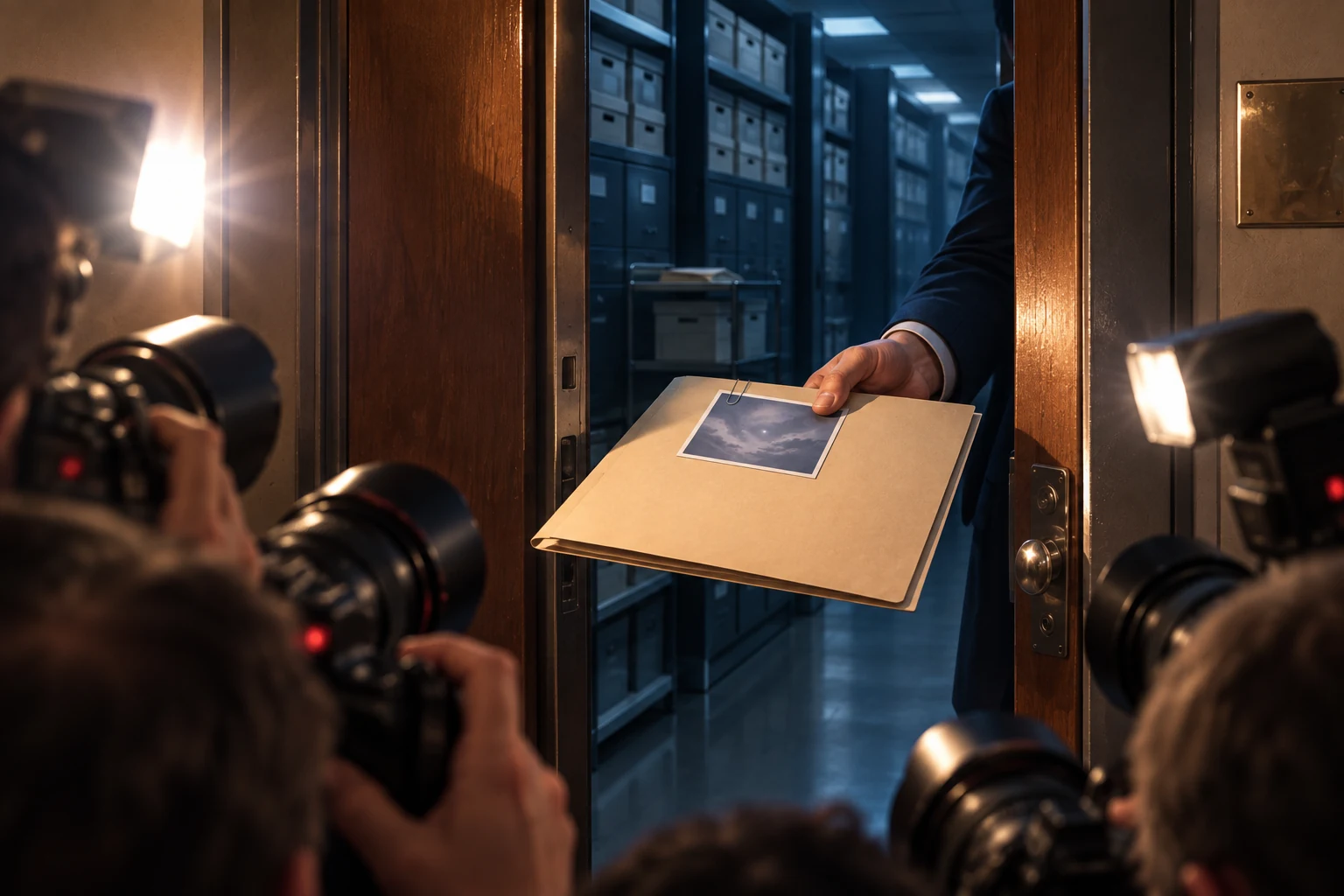
A folder passes through a partly open records-room door as cameras gather outside.
The announcement, and the timing · Explore the conversation

Politics aside for a second—whether you like Trump or not—why is this subject useful to this administration?

That was one of my biggest questions listening to Elizondo talk about the incoming administration’s appetite for disclosure. There could be genuine interest. There’s public pressure. And being the person who finally opens the files is a pretty appealing part to play. I mean, people have been waiting for that entrance for decades.

Looking back, some things did happen. A House UAP hearing took place in September 2025. Trump directed a file-release effort in February 2026, and the official PURSUE portal listed five releases by August. House hearing, released records.

But somebody is choosing which examples go in front of us. Are we seeing unfamiliar technology? A security problem? Cases with too little information to settle anything? The portal describes unresolved cases; that alone doesn’t tell us what an object is.

And think about the moment these files are arriving in. AI is already making people reconsider what technology can do. Suppose you keep seeing a strange craft discussed alongside breakthroughs that would have sounded ridiculous a few years earlier. After a while, does that craft feel a little less impossible?

That’s the possibility I keep turning over. Maybe people become more open to something extraordinary because the supposedly ordinary world is already getting pretty damn strange.

Which could make this an easier time to introduce a bigger story. It could also make a useful political moment out of public curiosity. I don’t know how much of that is intentional. But I’d like to know what the people selecting the material hope we take away from it.

There’s a longer history behind the releases, too. The National Archives collection comes out of earlier legislation. One administration’s announcement isn’t the beginning of everybody else’s work.

Still, I don’t want the whole conversation to become cheering or booing whoever is at the microphone. We could spend the entire time fighting about Trump and barely discuss the weird thing we were just shown.

I wanted the door opened. Of course I’m going to look inside. But if somebody’s giving us a tour, I’m also going to wonder why we stopped at these particular rooms.

Veya’s take
Hear it for yourselfWatch this part of Elizondo and Pasulka’s conversation.

Opens YouTube in a new tab at the start of the range.